Stage Ingestion Orchestrator
ProfessionalEnterprise
| Image | $DATAOPS_STAGEINGESTION_RUNNER_IMAGE |
|---|---|
| Feature Status | PubPrev |
The Stage Ingestion orchestrator ingests data from Snowflake stages into tables defined in the Snowflake configuration.
Multiple tables may be ingested, and these will run in parallel.
Usage
You must use the Stage Ingestion orchestrator with SOLE for Data Products. SOLE will create the tables, file formats, and stages the Stage Ingestion orchestrator needs.
The preview release currently supports ingestion from AWS S3 stages created by SOLE.
Supported parameters
| Parameter | Required/Default | Description |
|---|---|---|
DATAOPS_DIRECT_INGESTION_ACTION |
REQUIRED | Must be START |
CONFIGURATION_DIR |
REQUIRED | Set to $CI_PROJECT_DIR/dataops/snowflake to read the default Snowflake configuration files |
DATAOPS_SOLE_ACCOUNT |
REQUIRED | The Snowflake account name to use |
DATAOPS_SOLE_USERNAME |
REQUIRED | The Snowflake username to use |
DATAOPS_SOLE_PASSWORD |
REQUIRED | The Snowflake password to use |
DATAOPS_SOLE_ROLE |
REQUIRED | The Snowflake role to use |
DATAOPS_SOLE_WAREHOUSE |
REQUIRED | The Snowflake warehouse to use |
Below is a typical job definition:
Stage Ingestion:
  extends:
    - .agent_tag
    - .should_run_ingestion
  image: $DATAOPS_STAGEINGESTION_RUNNER_IMAGE
  stage: "Batch Ingestion"
  variables:
    DATAOPS_STAGE_INGESTION_ACTION: START
    CONFIGURATION_DIR: $CI_PROJECT_DIR/dataops/snowflake
    # Adjust the values below if required, to ingest as the appropriate user/role
    DATAOPS_SOLE_ACCOUNT: DATAOPS_VAULT(SNOWFLAKE.ACCOUNT)
    DATAOPS_SOLE_USERNAME: DATAOPS_VAULT(SNOWFLAKE.TRANSFORM.USERNAME)
    DATAOPS_SOLE_PASSWORD: DATAOPS_VAULT(SNOWFLAKE.TRANSFORM.PASSWORD)
    DATAOPS_SOLE_ROLE: DATAOPS_VAULT(SNOWFLAKE.TRANSFORM.ROLE)
    DATAOPS_SOLE_WAREHOUSE: DATAOPS_VAULT(SNOWFLAKE.TRANSFORM.WAREHOUSE)
  # prevent parallel ingestion for the same tables on the same branch
  resource_group: $CI_JOB_NAME
  script:
    - /dataops
  icon: ${SNOWFLAKEOBJECTLIFECYCLE_ICON}
Configuration tables for ingestion
You can configure the tables to be ingested in the Snowflake configuration files, which SOLE also reads. For each table, you can define an orchestrators: section.
This section contains a stage_ingestion: section defining the ingestion parameters. Supported parameters are:
| Parameter | Required/Default | Description |
|---|---|---|
stage |
REQUIRED | The stage name containing the data. Currently, this must be in the same schema as the destination table. |
file_format |
REQUIRED | The file format name to be used to process the data. Currently, this must be in the same schema as the destination table. |
path |
REQUIRED | The path to the data file(s) inside the stage. This is appended to the stage name in the COPY INTO command. |
method |
Optional. Defaults to append |
append or full_load. full_load will truncate the table before ingestion. Not yet implemented. |
truncate |
Optional. Defaults to false |
true or false. Whether to truncate before ingestion. To be removed in a future release. |
copy |
Optional | A key-value pair dictionary of options to be passed to the Snowflake COPY INTO command. See copy parameters for a definition of copy |
pattern |
Optional | A regular expression pattern string, enclosed in single quotes, specifying the file names and/or paths to match. |
COPY INTO <table>
copy parameters
The copy parameter supports the following parameters:
| Configuration Key | Required/Optional | Data Types and Values |
|---|---|---|
size_limit |
Optional | Integer |
force |
Optional | Boolean |
purge |
Optional | Boolean |
return_failed_length |
Optional | Boolean |
enforce_length |
Optional | Boolean |
truncatecolumns |
Optional | Boolean |
load_uncertain_files |
Optional | Boolean |
match_by_column_name |
Optional | String: CASE_SENSITIVE, CASE_INSENSITIVE, NONE |
See the Snowflake doc section for more information.
An example is shown below:
databases:
  "{{ env.DATAOPS_DATABASE }}":
    schemas:
      SCHEMA1:
        tables:
          NASA_PATENTS:
            columns:
              CENTER:
                type: TEXT
              STATUS:
                type: TEXT
              CASE_NUMBER:
                type: TEXT
              PATENT_NUMBER:
                type: VARCHAR(255)
              APPLICATION_SN:
                type: TEXT
              TITLE:
                type: TEXT
              PATENT_EXPIRATION_DATE:
                type: DATE
              _METADATA_FILENAME:
                type: VARCHAR(255)
              _METADATA_ROWNUM:
                type: NUMBER(38,0)
              _METADATA_INGEST_DATE:
                type: TIMESTAMP_NTZ(9)
            orchestrators:
              stage_ingestion:
                stage: DOL_SOURCE_BUCKET
                file_format: CSV_FORMAT
                path: csv/NASA_Patents.csv
                truncate: true
                copy:
                  force: true
          DISCHARGE_REPORT_BY_CODE_MS_2:
            columns:
              GEOGRAPHIC_UNIT:
                type: TEXT
              STUDENT_CATEGORY:
                type: TEXT
              CODE:
                type: TEXT
              CODE_TYPE:
                type: TEXT
              DESCRIPTION_OF_CODE:
                type: TEXT
              COUNT_OF_STUDENTS:
                type: VARCHAR(255)
              TOTAL_ENROLLED_STUDENTS:
                type: NUMBER
            orchestrators:
              stage_ingestion:
                stage: SOURCE_STAGE
                file_format: CSV_FORMAT
                PATH: csv
                PATTERN: ".*/.*/.*[.]csv"
                truncate: true
                copy:
                  force: true
                  size_limit: 6000
                  purge: true
                  return_failed_length: true
                  enforce_length: true
                  truncatecolumns: false
                  load_uncertain_files: true
          BEHAVIORAL_RISK_FACTOR_SURVEILLANCE_SYSTEM:
            columns:
              DATA:
                type: VARIANT
            orchestrators:
              stage_ingestion:
                stage: SOURCE_STAGE
                file_format: PARQUET_FORMAT
                PATH: parquet/Behavioral_Risk_Factor_Surveillance_System__BRFSS__Prevalence_Data__2011_to_present_.parquet
                truncate: true
                copy:
                  force: true
          ASSET_OUTAGE:
            comment: "assetOutage from eNAMS"
            columns:
              JSON_DATA:
                type: VARIANT
            orchestrators:
              stage_ingestion:
                stage: external_data_stage
                file_format: JSON_FORMAT
                file_type: json
                path: json/history_asset_outage.json
                truncate: true
                copy:
                  force: true
- database:
    name: "{{ env.DATAOPS_DATABASE }}"

- schema:
    name: SCHEMA1
    database: rel(database.{{env.DATAOPS_DATABASE }})

- table:
    name: NASA_PATENTS
    database: rel(database.{{ env.DATAOPS_DATABASE }})
    schema: rel(schema.SCHEMA1)
    columns:
      CENTER:
        type: TEXT
      STATUS:
        type: TEXT
      CASE_NUMBER:
        type: TEXT
      PATENT_NUMBER:
        type: VARCHAR(255)
      APPLICATION_SN:
        type: TEXT
      TITLE:
        type: TEXT
      PATENT_EXPIRATION_DATE:
        type: DATE
      _METADATA_FILENAME:
        type: VARCHAR(255)
      _METADATA_ROWNUM:
        type: NUMBER(38,0)
      _METADATA_INGEST_DATE:
        type: TIMESTAMP_NTZ(9)
    orchestrators:
      stage_ingestion:
        stage: DOL_SOURCE_BUCKET
        file_format: CSV_FORMAT
        path: csv/NASA_Patents.csv
        truncate: true
        copy:
          force: true
- table:
    name: DISCHARGE_REPORT_BY_CODE_MS_2
    database: rel(database.{{ env.DATAOPS_DATABASE }})
    schema: rel(schema.SCHEMA1)
    columns:
      GEOGRAPHIC_UNIT:
        type: TEXT
      STUDENT_CATEGORY:
        type: TEXT
      CODE:
        type: TEXT
      CODE_TYPE:
        type: TEXT
      DESCRIPTION_OF_CODE:
        type: TEXT
      COUNT_OF_STUDENTS:
        type: VARCHAR(255)
      TOTAL_ENROLLED_STUDENTS:
        type: NUMBER
    orchestrators:
      stage_ingestion:
        stage: SOURCE_STAGE
        file_format: CSV_FORMAT
        PATH: csv
        PATTERN: ".*/.*/.*[.]csv"
        truncate: true
        copy:
          force: true
          size_limit: 6000
          purge: true
          return_failed_length: true
          enforce_length: true
          truncatecolumns: false
          load_uncertain_files: true
- table:
    name: BEHAVIORAL_RISK_FACTOR_SURVEILLANCE_SYSTEM
    database: rel(database.{{ env.DATAOPS_DATABASE }})
    schema: rel(schema.SCHEMA1)
    columns:
      DATA:
        type: VARIANT
    orchestrators:
      stage_ingestion:
        stage: SOURCE_STAGE
        file_format: PARQUET_FORMAT
        PATH: parquet/Behavioral_Risk_Factor_Surveillance_System__BRFSS__Prevalence_Data__2011_to_present_.parquet
        include_metadata: true | false
        method: append | full_load
        post_hook: sql|shell
        truncate: true
        copy:
          force: true
          match_by_column_name: CASE_INSENSITIVE
- table:
    name: ASSET_OUTAGE
    database: rel(database.{{ env.DATAOPS_DATABASE }})
    schema: rel(schema.SCHEMA1)
    columns:
      JSON_DATA:
        type: VARIANT
    orchestrators:
      stage_ingestion:
        stage: SOURCE_STAGE
        file_format: JSON_FORMAT
        file_type: json
        path: json/history_asset_outage.json
        truncate: true
        copy:
          force: true
          match_by_column_name: CASE_INSENSITIVE
Adding metadata columns
You can add several special columns to a table definition. If a column is present in the table definition, the ingestion process will populate the column as part of the ingestion. The current set of columns is:
| Column name | Contents |
|---|---|
| _METADATA_FILENAME | The file that the data came from. |
| _METADATA_ROWNUM | The row in the file that the data came from. |
| _METADATA_INGEST_DATE | The database date and time that the data was ingested. |
| _METADATA_JOB_ID | The DataOps.live job ID that ran the ingestion. |
| _METADATA_PIPELINE_ID | The DataOps.live pipeline ID that ran the ingestion. |
| _METADATA_BRANCH_NAME | The DataOps.live branch that ran the ingestion. |
Loading files using column matching
Load files from an external stage into the table with the match_by_column_name copy option. This involves performing a case-insensitive match between the column names in the files and those defined in the table. This option allows flexibility, as the column ordering in the files does not have to align with the column ordering in the table.
databases:
  "{{ env.DATAOPS_DATABASE }}":
    schemas:
      SCHEMA1:
        tables:
          BEHAVIORAL_RISK_FACTOR_SURVEILLANCE_SYSTEM:
            columns:
              BREAKOUTCATEGORYID:
                type: VARCHAR
              BREAK_OUT:
                type: VARCHAR
              BREAK_OUT_CATEGORY:
                type: VARCHAR
              BREAKOUTID:
                type: VARCHAR
              CLASSID:
                type: VARCHAR
              CONFIDENCE_LIMIT_HIGH:
                type: VARCHAR
              DATASOURCE:
                type: VARCHAR
              DATA_VALUE_FOOTNOTE_SYMBOL:
                type: VARCHAR
              DATA_VALUE:
                type: VARCHAR
              DISPLAY_ORDER:
                type: VARCHAR
              GEOLOCATION:
                type: VARCHAR
              LOCATIONID:
                type: VARCHAR
              QUESTIONID:
                type: VARCHAR
              RESPONSEID:
                type: VARCHAR
              TOPICID:
                type: VARCHAR
              YEAR:
                type: VARCHAR
            orchestrators:
              stage_ingestion:
                stage: SOURCE_STAGE
                file_format: PARQUET_FORMAT
                PATH: parquet/Behavioral_Risk_Factor_Surveillance_System__BRFSS__Prevalence_Data__2011_to_present_.parquet
                include_metadata: true | false
                method: append | full_load
                post_hook: sql|shell
                truncate: true
                copy:
                  force: true
                  match_by_column_name: CASE_INSENSITIVE
          ASSET_OUTAGE:
            comment: "assetOutage from eNAMS"
            columns:
              EN_NASAP_Circuit_Code__c:
                type: VARCHAR(50)
              EN_Record_Type_Name__c:
                type: VARCHAR(50)
              Name:
                type: VARCHAR(50)
              EN_Outage__c:
                type: VARCHAR(50)
              LastModifiedDate:
                type: VARCHAR(50)
              IsDeleted:
                type: VARCHAR(50)
              Id:
                type: VARCHAR(50)
            orchestrators:
              stage_ingestion:
                stage: SOURCE_STAGE
                file_format: JSON_FORMAT
                file_type: json
                path: json/history_asset_outage.json
                truncate: true
                copy:
                  force: true
                  match_by_column_name: CASE_INSENSITIVE
- database:
    name: "{{ env.DATAOPS_DATABASE }}"

- schema:
    name: SCHEMA1
    database: rel(database.{{ env.DATAOPS_DATABASE }})

- table:
    name: BEHAVIORAL_RISK_FACTOR_SURVEILLANCE_SYSTEM
    database: rel(database.{{ env.DATAOPS_DATABASE }})
    schema: rel(schema.SCHEMA1)
    columns:
      BREAKOUTCATEGORYID:
        type: VARCHAR
      BREAK_OUT:
        type: VARCHAR
      BREAK_OUT_CATEGORY:
        type: VARCHAR
      BREAKOUTID:
        type: VARCHAR
      CLASSID:
        type: VARCHAR
      CONFIDENCE_LIMIT_HIGH:
        type: VARCHAR
      DATASOURCE:
        type: VARCHAR
      DATA_VALUE_FOOTNOTE_SYMBOL:
        type: VARCHAR
      DATA_VALUE:
        type: VARCHAR
      DISPLAY_ORDER:
        type: VARCHAR
      GEOLOCATION:
        type: VARCHAR
      LOCATIONID:
        type: VARCHAR
      QUESTIONID:
        type: VARCHAR
      RESPONSEID:
        type: VARCHAR
      TOPICID:
        type: VARCHAR
      YEAR:
        type: VARCHAR
    orchestrators:
      stage_ingestion:
        stage: SOURCE_STAGE
        file_format: PARQUET_FORMAT
        PATH: parquet/Behavioral_Risk_Factor_Surveillance_System__BRFSS__Prevalence_Data__2011_to_present_.parquet
        include_metadata: true | false
        method: append | full_load
        post_hook: sql|shell
        truncate: true
        copy:
          force: true
          match_by_column_name: CASE_INSENSITIVE
- table:
    name: ASSET_OUTAGE
    database: rel(database.{{ env.DATAOPS_DATABASE }})
    schema: rel(schema.SCHEMA1)
    comment: "assetOutage from eNAMS"
    columns:
      EN_NASAP_Circuit_Code__c:
        type: VARCHAR(50)
      EN_Record_Type_Name__c:
        type: VARCHAR(50)
      Name:
        type: VARCHAR(50)
      EN_Outage__c:
        type: VARCHAR(50)
      LastModifiedDate:
        type: VARCHAR(50)
      IsDeleted:
        type: VARCHAR(50)
      Id:
        type: VARCHAR(50)
    orchestrators:
      stage_ingestion:
        stage: SOURCE_STAGE
        file_format: JSON_FORMAT
        file_type: json
        path: json/history_asset_outage.json
        truncate: true
        copy:
          force: true
          match_by_column_name: CASE_INSENSITIVE
Loading using pattern matching
Load data from compressed CSV files located in any path within a table's stage using pattern matching, and then populate the table with the loaded data.
databases:
  "{{ env.DATAOPS_DATABASE }}":
    schemas:
      SCHEMA1:
        tables:
          DISCHARGE_REPORT_BY_CODE_MS_2:
            columns:
              GEOGRAPHIC_UNIT:
                type: TEXT
              STUDENT_CATEGORY:
                type: TEXT
              CODE:
                type: TEXT
              CODE_TYPE:
                type: TEXT
              DESCRIPTION_OF_CODE:
                type: TEXT
              COUNT_OF_STUDENTS:
                type: VARCHAR(255)
              TOTAL_ENROLLED_STUDENTS:
                type: NUMBER
            orchestrators:
              stage_ingestion:
                stage: SOURCE_STAGE
                file_format: CSV_FORMAT
                PATH: csv
                PATTERN: ".*/.*/.*[.]csv"
                truncate: true
                copy:
                  force: true
                  size_limit: 6000
                  purge: true
                  return_failed_length: true
                  enforce_length: true
                  truncatecolumns: false
                  load_uncertain_files: true
- database:
    name: "{{ env.DATAOPS_DATABASE }}"

- schema:
    name: SCHEMA1
    database: rel(database.{{ env.DATAOPS_DATABASE }})

- table:
    name: DISCHARGE_REPORT_BY_CODE_MS_2
    database: rel(database.{{ env.DATAOPS_DATABASE }})
    schema: rel(schema.SCHEMA1)
    columns:
      GEOGRAPHIC_UNIT:
        type: TEXT
      STUDENT_CATEGORY:
        type: TEXT
      CODE:
        type: TEXT
      CODE_TYPE:
        type: TEXT
      DESCRIPTION_OF_CODE:
        type: TEXT
      COUNT_OF_STUDENTS:
        type: VARCHAR(255)
      TOTAL_ENROLLED_STUDENTS:
        type: NUMBER
    orchestrators:
      stage_ingestion:
        stage: SOURCE_STAGE
        file_format: CSV_FORMAT
        PATH: csv
        PATTERN: ".*/.*/.*[.]csv"
        truncate: true
        copy:
          force: true
          size_limit: 6000
          purge: true
          return_failed_length: true
          enforce_length: true
          truncatecolumns: false
          load_uncertain_files: true
Where .\* is interpreted as “zero or more occurrences of any character.” The square brackets escape the period character (.) that precedes a file extension.
Loading JSON data into a VARIANT column
The following example loads JSON data into a table with a single column of type VARIANT.
{
  "EN_NASAP_Circuit_Code__c": "Circuit123",
  "EN_Outage__c": true,
  "EN_RECORD_Type_Name__c": "TypeA",
  "Id": "12345",
  "IsDeleted": false,
  "LastModifiedDate": "2023-10-24T14:30:00",
  "Name": "AssetA"
}
databases:
  "{{ env.DATAOPS_DATABASE }}":
    schemas:
      SCHEMA1:
        tables:
          ASSET_OUTAGE:
            comment: "assetOutage from eNAMS"
            columns:
              JSON_DATA:
                type: VARIANT
            orchestrators:
              stage_ingestion:
                stage: external_data_stage
                file_format: JSON_FORMAT
                file_type: json
                path: json/history_asset_outage.json
                truncate: true
                copy:
                  force: true
- database:
    name: "{{ env.DATAOPS_DATABASE }}"

- schema:
    name: SCHEMA1
    database: rel(database.{{ env.DATAOPS_DATABASE }})

- table:
    name: ASSET_OUTAGE
    database: rel(database.{{ env.DATAOPS_DATABASE }})
    schema: rel(schema.SCHEMA1)
    comment: "assetOutage from eNAMS"
    columns:
      JSON_DATA:
        type: VARIANT
    orchestrators:
      stage_ingestion:
        stage: external_data_stage
        file_format: JSON_FORMAT
        file_type: json
        path: json/history_asset_outage.json
        truncate: true
        copy:
          force: true
Bulk loading from Amazon S3
Use the COPY INTO <table> command to transfer the data from the staged files into a table within a Snowflake database. While it's possible to load directly from the bucket, Snowflake advises creating an external stage that points to the bucket and utilizing the external stage instead.
Irrespective of the chosen method, this process mandates a currently active virtual warehouse for the session. Whether executing the command manually or within a script, the warehouse furnishes the computational resources necessary for the insertion of rows into the table.
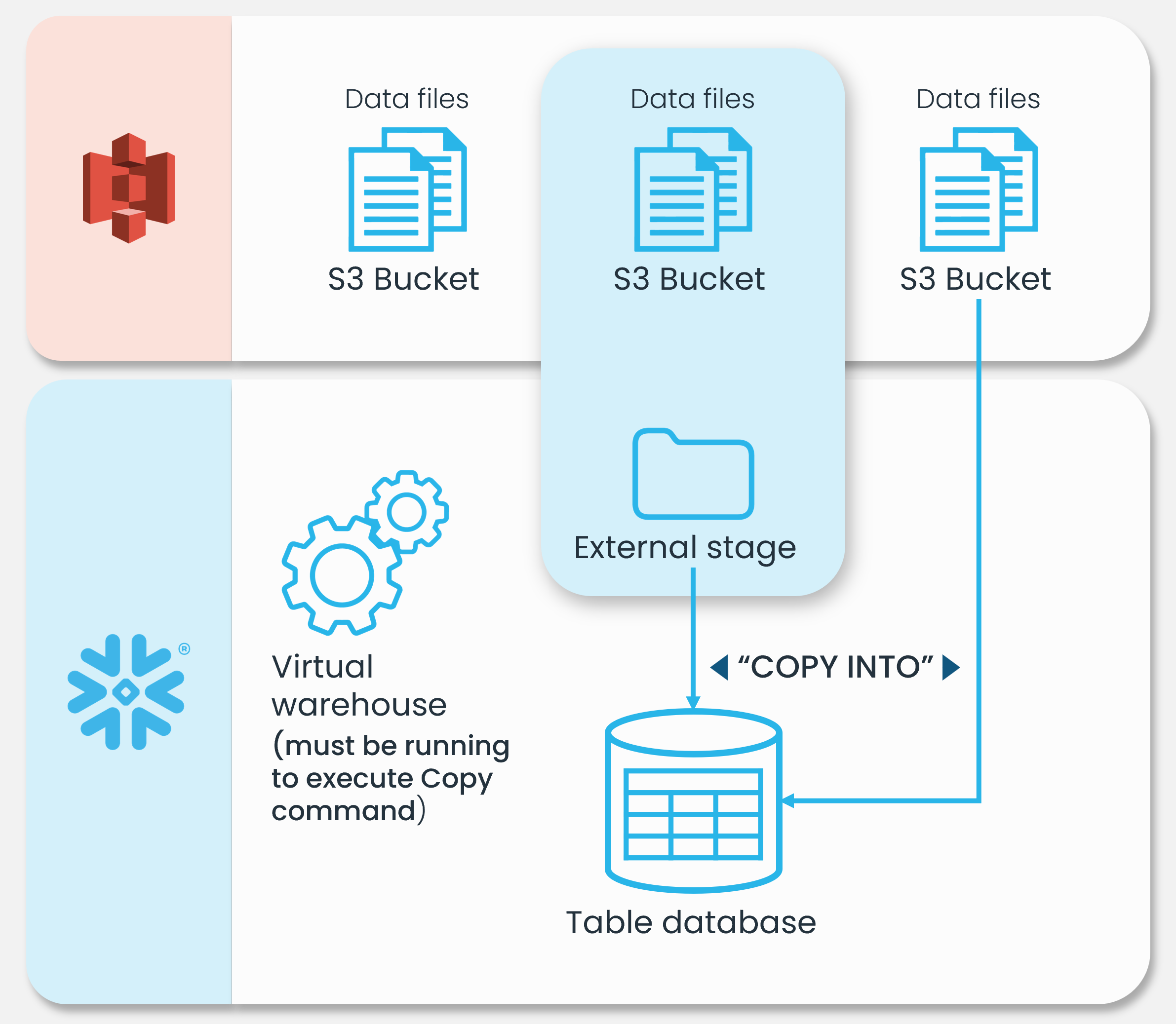
See the Snowflake documentation for more information.
Authentication
Key-pair authentication
The Stage Ingestion Orchestrator supports using key-pair authentication. To learn how to configure it, see key-pair authentication.
Auto-Generating sources from SOLE ingestion tables
Eliminate the need for manual addition of dbt sources by sharing table definitions between Snowflake Object Lifecycle Engine (SOLE) and Modelling and Transformation Engine (MATE). This streamlines onboarding for new data sources, reduces time to launch projects, and prevents duplicated efforts.
Sharing SOLE configuration files enables automatic metadata generation and transformation into ready-to-use MATE sources, providing a significant productivity advantage by eliminating the need for duplicate table definitions.
See the Auto-Generating Sources from SOLE Ingestion Tables documentation for more information.
For more information about generating sources for tables not managed by SOLE, see Generating Sources for Tables Managed Outside SOLE.